Thursday, July 12, 2012

The sinking of Battleship


Peter Berg's alien invasion film Battleship is arguably the biggest failure of the 2012 summer movie season. As I write this, the film, which cost in excess of $200 million to produce, has grossed a paltry $65 million in the United States after having been in release for nearly two months. (A discussion of box office receipts is perhaps the only time I'll unironically use the word "paltry" when referring to tens of millions of dollars.) The overall critical reaction to the film was unsurprisingly savage, as it represents nearly everything serious film critics despise: it's big, it's dumb, it's loud and it's derivative. But let's be honest; critics rarely influence the moviegoing public, and I expected the film to do at least somewhat better business than it has. What I have found surprising is the largely ambivalent, even negative reaction to the film among moviegoers and internet commentators. Clearly, based on its box office returns, a lot of people simply chose not to see Battleship, and after reading a lot of what's been written about it, you would expect it to be one of the worst films ever made. But it isn't, not by a long shot. I saw it in a theater, and I have to say, it's not that bad. I thought it was perfectly enjoyable, and I certainly didn't walk out of the theater regretting having seen the film. (It may have helped matters somewhat that we saw it for free by using a gift card.) Although the plot was ridiculous to say the least, the acting was reasonably competent, the special effects were spectacularly well-done, and overall, I was honestly entertained more than I expected to be. I'm not going to expend any more words trying to defend the film (at least not in this paragraph), because on a certain level, it's indefensible. An obscene amount of money was spent to produce this film, but that's nothing out of the ordinary in today's Hollywood; it only becomes an issue when that money isn't recouped. The bottom line is, either you'll have fun with Battleship or you won't, but frankly, I'm mystified as to why it bombed so thoroughly, and I'd like to try and figure out why.


I'll bet they're feeling a bit inadequate

First of all, the argument that it tanked because it's a dumb movie is invalid. It's not like stupid movies haven't cleaned up at the box office in the past; just look at Michael Bay's Transformers series, which Battleship actually has a lot in common with. Both were developed by the toy company Hasbro based on their products, both feature robotic alien machinery that can reconfigure itself into different objects, and both are, well, stupid. That's where the similarities end, however. The three Transformers films (of which, full disclosure here, I've only seen the first), have grossed well over a billion dollars in the US alone. On the Rotten Tomatoes website, which tracks a film's popularity among both critics and audiences, Battleship receives a dismal 34% score from critics and doesn't fare much better with audiences, who score it at 56%. By contrast, the first Transformers movie scored 57% with critics and 89% with audiences. Why the huge difference? Is Transformers really a better movie? If you asked me, I'd say no. While I enjoyed the first film to a certain degree, it clearly didn't make me want to rush out and see the other two films upon their release. I haven't even bothered to rent them yet. Transformers is deafening, obnoxious and infantile to a much greater degree than Battleship, and personally, I find the star of the series, Shia LaBoeuf, to be irritating, much more so than Battleship star Taylor Kitsch. Speaking of Kitsch, he was also the lead in another huge 2012 flop, John Carter, leading some people to hypothesize that he's somehow box office poison. I think it's just bad luck on his part. No, despite the recent, massive success of a truly intelligent and thought-provoking sci-fi/action film like Christopher Nolan's Inception (or for that matter, his Batman films), the fact remains that dumb movies are as popular as ever (Twilight, anyone?).

"Get to the choppa! Wait, get away from the choppa!"

I suspect the fact that Battleship's lowly origin - it is, in fact, based on a board game - has a lot to do with its negative perception. Like a lot of people, I groaned inwardly when I first heard about it. Hollywood's well of inspiration has been pretty dry as of late; they've gone from remakes of foreign films to "reboots" of their own properties to movies based on TV shows and video games. Basing a film on a board game would seem to be the absolute nadir of creativity, and to a certain extent, it is. Countless jokes along the lines of, "What's next, Chutes and Ladders: The Movie?" were made when Battleship was first announced, and I laughed along with them. Speculation ran high as to whether or not someone in the film would utter the famous line, "You sank my battleship!" in a petulant tone, as seen in the TV commercials for the game. The fact is, however, that Battleship the movie has next to nothing to do with Battleship the game. This rather tenuous connection was nothing more than an attempt to align the film with a familiar and beloved product to boost its visibility, and in this case, it backfired horribly. When you strip all that away, however, what you're left with is an alien invasion flick that has far more in common with other films of its ilk, such as Independence Day and War of the Worlds, than with any game. If Battleship had been called something else entirely and had not been promoted as an adaptation of a board game, it might have done better. This also might explain why it's done reasonably well outside the United States, pulling in over $200 million overseas. The connection with the game may have gone over the heads of non-US viewers who aren't familiar with it and therefore it avoided the negative connotations associated with that relationship.

A snazzy suit of alien armor
Ultimately, though, I think Battleship's failure was mainly the result of unfortunate timing. To see what I mean, you only have to go back two weeks in time from its opening date (May 18) and look at which movie premiered on that date: The Avengers. This admittedly superior film became an unstoppable box office juggernaut that simply left no room for an also-ran like Battleship. The Avengers has grossed nearly ten times as much as Battleship has. It's a better film, yes, but is it ten times better? With all due respect to Joss Whedon and crew, of course not, but that's not really a valid comparison anyway. Any sci-fi/action film that went head to head with The Avengers would have had its work cut out for it, and Battleship just wasn't up to the task. What I don't quite understand is why Battleship didn't benefit more from spill-over business from The Avengers. I'm sure a lot of people who wanted to see The Avengers were turned away due to sold out shows, and I would have expected a healthy percentage of those people to have elected to see Battleship as an alternative. I guess they either walked away or bought tickets to a later showing of The Avengers instead. Of course, it's also possible that Battleship only made as much money as it did because of the patronage of those disappointed moviegoers. I suppose the studio could have played up the patriotic aspect of the film a bit more (it features real-life war veterans in both small and leading roles), seeing as how it opened around Memorial Day, but that probably wouldn't have helped much. In retrospect, if they had waited until July 4th to release the film, things might have worked out slightly better, although they would still have been competing with The Amazing Spiderman and then, two weeks later, The Dark Knight Rises.

Someone just read the reviews to Liam Neeson

We may never really know why Battleship failed so resoundingly. It's worth noting that the film does have its supporters (or at the very least, its apologists). I looked up Roger Ebert's review; while he dutifully points out all of the film's faults, he gives it two and a half stars, and he and I are on the same page about it being better than Transformers (yes, I just compared myself to Roger Ebert). Nick Pinkerton's amusingly witty review in The Village Voice is what ultimately made me decide to see the film; in particular, the last line of the review, which reads, "And when the F-14s came out for a triumphant flyover, I looked around the room to find the moron who was applauding only to realize that it was me." Finally, while searching the web for photos to accompany this post, I stumbled upon another blog post whose rather high-profile author saw Battleship back-to-back with The Avengers and ultimately found Battleship to be more satisfying. The blogger? Oliver Stone. It will be interesting to see if the film develops any sort of second life on home video (at the very least, as the subject of some sort of drinking game). I definitely think it's worth a repeat viewing, especially if you have a decent home theater system that can approximate the room-shaking quality of the theatrical experience, and it's highly likely that I'll rent it, or even buy it on Blu-ray, if the price is right (say, ten bucks or less). While I've found most of director Peter Berg's other films to be instantly forgettable, for once, he made one that I'd like to see again, and it bombed. I feel his pain.

Saturday, July 7, 2012

Let's talk about violence

One of the first of countless casualties in The Wild Bunch

"...I feel totally great and fine in saying that in real life I have a major problem with violence, that I do think our society is too violent, but I have no problem going to a film and seeing violence on the screen." 
-- Quentin Tarantino

"When people talk about violence in cinema, it's like talking about cheese on pasta; it sort of comes with the dish." 
-- Brian De Palma

Let's take a cue from Mr. De Palma and discuss violence a bit, shall we? It's something that's going to come up again and again in this blog (in fact, I already touched on it a bit in my first few entries), and there are a few things I feel I should get out in the open. I recently watched the special edition DVD of The Enforcer, and one of the special features was a documentary featuring various filmmakers and film historians frankly discussing the pros and cons of cinematic violence. It was an interesting show, and it got me thinking about my views on the subject. First of all, let me say that I am in no way, shape or form a violent person. In general, I'm what you would refer to as a bleeding heart liberal (if you want proof, see the post immediately prior to this one). I've never been in a real fight, I've never raised my hand in anger against anyone, I despise war and I'm against capital punishment and solidly in favor of gun control. Despite all this, I find myself watching a lot of violent movies. All you have to do is look through a list of some of my favorite films - Taxi Driver, The Wild Bunch, Apocalypse Now, Drive, A Clockwork Orange, Alien, Dirty Harry, The Godfather and The Godfather Part II, Once Upon a Time in the West and countless blood-drenched horror films you've probably never heard of - to see that violence is an integral part of my film diet. In my view, many of the most interesting and intriguing films also happen to be the most violent. How can this be? How can such a mild-mannered person as myself derive pleasure from watching brutality take place on the screen? Well, it's complicated. You know, like life.

A reluctant execution in Army of Shadows

In my mind, there are different types of screen violence. First of all, there's violence that's supposed to be ugly, that's supposed to repulse the viewer and demonstrate to them how horrible violence really is. This is what I consider to be, more or less, realistic violence. You'll find it in many of the films of Sam Peckinpah, or Steven Spielberg's Saving Private Ryan, or Wes Craven's The Last House on the Left, or Jean-Pierre Melville's L'armée des ombres (Army of Shadows). When you watch a violent sequence in one these films, it's the filmmakers' intention that you should be sickened by it. In many cases, the characters in the films who perpetrate the violence are sickened by it as well. It couldn't possibly be argued that a well-adjusted person would view these films and get the idea that violence is a positive thing (although that hasn't stopped a never-ending stream of pundits from trying to do just that over virtually the entire history of the cinema). At the very least, it's shown to be repugnant but necessary. Melville's film contains an incredibly powerful scene in which members of the French resistance during World War II reluctantly kill an informer who would otherwise give them away to the Nazis; the necessity of doing it quietly and cleanly means that they have to strangle him, and it's absolutely excruciating to watch, despite the fact that it's not at all graphic.

With that being said, many of the violent sequences in these films are nevertheless filmed and presented in a way that is visually and cinematically exciting. Scenes like the Normandy invasion in Private Ryan or the opening and closing gun battles in The Wild Bunch are horrifying, yes, but there's no denying the fact that the bravura expression of sheer cinematic technique utilized in these sequences is thrilling in its own right, and is somehow artistically divorced from the content itself. In short, it's possible to admire them even as you're appalled by them. (By contrast, the rape/murder sequences in Last House on the Left are filmed so dispassionately and with such a lack of flourish that they become practically unbearable to watch.) The argument has been put forth that these films somehow condone violence merely by presenting it, but the idea that exhibiting violence in a graphic manner is tantamount to condoning it seems ludicrous to me. Film is no different than other forms of art. If I look at Picasso's Guernica and say "Goddamn, that's an amazing painting," does that mean I think it's OK for fascists to bomb a town full of women and children into splinters? Of course not. Cinematic violence of this type can justifiably be referred to as an artist making a statement about society. 

Steven Seagal wants to talk to you about your behavior

Another type of screen violence, which is somewhat more problematic, is the type that isn't supposed to turn us off. It's the kind we're actually supposed to, well, enjoy. It's heroes taking out villains by any means necessary. It's Charles Bronson blowing away a scumbag rapist, or John Rambo using an explosive-tipped arrow to detonate a Vietnamese soldier, or Steven Seagal kicking the living shit out of a terrorist. It's violence that's supposed to elicit a cheer from the audience, or a giggle, or at the very least, a satisfied sigh. This is the type of violence that worries some people, and to a certain extent, I can understand why. The violence in these films is presented as less consequential, or even inconsequential. In most cases, we aren't shown the bad guys' pain at any great length, or the grief of their loved ones (if they have any; more often than not, they exist in a vacuum), or the circumstances that made them the way they were. The filmmakers aren't interested in those things, nor are we supposed to be, and as a result, those on the receiving end of this "righteous" violence are dehumanized.

Raiders of the Lost Ark (my daughter said he screamed like a girl)

Of course, the antagonists in police dramas and action movies are often presented as unrepentantly evil to begin with, and that is, in my opinion, the key to being able to enjoy these films without feeling too guilty about it. These aren't characters; they're caricatures, and sometimes it's nice to visit a world in which everything is black and white (in a moral sense). In the documentary I mentioned earlier, screenwriter Shane Black says something to the effect of "It's fun to see the bad guy get blown the fuck out of his socks," and I tend to agree. As I write this, I'm preparing to take my nine-year-old daughter to a theatrical screening of Raiders of the Lost Ark. She might be a bit young for it, but it's a rare opportunity to see this classic film on the big screen, and I want to take advantage of it in the hope that it will help kindle a love of film in her (much the same as it did for me). I was discussing with a relative whether or not I'd need to cover her eyes at the climax, when Belloq and the Nazi villains are gruesomely obliterated by the Ark, and he remarked, "Well, they deserve it!" That sums it up right there. Movie villains always deserve it. There's no doubt that they've committed their crimes; hell, we've seen them do it, and we've got the film to prove it! This absolute certainty squelches many of my moral reservations about seeing them wiped out. Speaking of Raiders, has the scene where Indy shoots the sword-wielding baddie ever failed to elicit an uproarious laugh from the audience? Like it or not, sometimes violence is just fucking hilarious! (I did end up letting my daughter watch the end; she remarked that the melting Nazi "screamed like a girl," and later, we discussed how the effects were accomplished.)

Riverdance this is not - Ryan Gosling in Drive

Some filmmakers do try to have it both ways. In Nicolas Winding Refn's stunning crime film Drive, Ryan Gosling's unnamed character commits some intense acts of violence in the course of protecting a young mother and her son from vicious gangsters. While his motives may be good and pure, he's obviously got some issues of his own, as evidenced by the extreme methods he uses. In Drive's most infamous scene, when confronted in an elevator, he repeatedly stomps on a thug's head until it resembles a pancake, and both the woman he's protecting in the film and we the audience are left in dumbstruck silence by his sheer ferocity. Or, there's The Matrix, in which we witness Keanu Reeves blowing away dozens of bad guys who, as it turns out, aren't even real. As much as I hate violence in real life, I have to admit I love watching it in movies of this ilk. The trick is to realize that they're just movies, and this sort of violent response to evil rarely works in the real world.

If I haven't said much yet about violence in horror films, it's because they're a different animal altogether. Horror films are specifically designed to confront us with our own mortality, and as such, the representation of violent death is an intrinsic part of their DNA. While it's entirely possible to make an effective horror film without explicit violence, since the late 1950s, these more subtle attempts at horror have increasingly been the exceptions to the rule. Horror films do often showcase violence as something ugly and reprehensible, as in Craven's Last House, but it's just as often presented as a visual spectacle, even more so than the action films referenced above. Horror fans watch these so-called "body count" films not only to be scared (if that even happens) but also to revel in the meticulously gory creations of special effects artists. We watch them for the specific purpose of seeing people dispatched in various messy ways, and we don't really care much about them at all. Of the thousands of characters who've been graphically butchered in horror films over the last five decades, many are often even greater ciphers than many of the action movie villains. The disposability of these victims is exacerbated by the fact that a good number of these horror films are low-budget affairs, with substandard writing and acting that don't do much to endear the characters to us. Violence is the raison d'être of these films; if you remove it, they're essentially pointless.

Alessio Orano delivers the coup de grâce in Lisa and the Devil

Again, there are quite a few exceptions. Neil Marshall's The Descent gives us a group of characters we grow to care about before they're plunged into a subterranean nightmare. We're terribly frightened for them and horrified by their brutal, ghastly deaths. We also root for them as they turn the tables on their subhuman tormentors and bring the pain back to them. Near the end, we're conflicted when one of them turns on another in retaliation for an earlier transgression; we understand, but we don't necessarily agree. Ultimately, we're emotionally shattered by the downbeat ending. Other horror films, while they may have their share of bloody moments, transcend these gruesome scenes and become truly exceptional films due to the sheer artistry on display. Mario Bava's 1972 horror masterpiece, Lisa and the Devil, features a number of grotesque murders, including a man who is run over repeatedly by a car and a half-dressed woman who is bludgeoned to death, but the film is so elegantly made and achieves such a remarkable, dreamlike quality that the violence doesn't seem as grotesque as it should. Other filmmakers play the violence for laughs, as in Sam Raimi's Evil Dead II. The gruesome dismemberments and popped-out eyeballs in Raimi's sequel to/remake of his own Evil Dead (which was a far more serious film) are famously inspired by the physically abusive comedy of The Three Stooges.

Whatever its context or presentation may be, violence in the cinema has been around since the very beginning, and it's not likely that it'll be going away anytime soon, despite the fact that many people would like it to. There's a group of people who seem to think that getting rid of violent movies will make our society less violent. That's patently absurd. While there are certain damaged individuals who may latch on to a violent film and find inspiration in it, is preventing everyone from seeing it really the answer? Won't these people just find something else that will set them off? One could argue that violence should be allowed in films if it has artistic merit, but who decides which films qualify? Ultimately, violent films are a reflection of our society as it is now. Perhaps someday, if and when we evolve to the point where we stop killing one another, these movies will become passé. While I'd love to live in a peaceful society, going to the movies in such a utopian world will sure be a hell of a lot more boring.

Wednesday, July 4, 2012

Today, we celebrate our Independence Day!


Happy Fourth of July, my fellow Americans! After a stirring speech by Bill Pullman, let's all band together and take our country back from the evil, slimy, inhuman creatures who would like nothing better than to enslave us and suck up all of our natural resources!


No, not those evil, slimy, inhuman creatures! 

  
These evil, slimy, inhuman creatures!

Have a great holiday!

Thursday, June 21, 2012

Robber, Pimp, Militant, Cop: Meet Albert Popwell.


(Note: As you may have noticed, it's been a long, long time since I posted anything here at Filmiliarity. I've been in school for the past several years, and my schoolwork has consumed the vast majority of my free time. I found it difficult to justify spending time writing blog entries when I had assignments due. Now that I'm finished, I do plan to post here much more frequently. While none of my blog posts are - in my estimation - particularly profound, this one is perhaps a bit more lightweight than usual. In fact, my inspiration for writing it came from a comment I left on another blog, Neil Fulwood's fascinating The Agitation of the Mind. Nevertheless, it was fun to write, and I wanted to get something out there to help me get back into the swing of things.)

It's fairly commonplace to have the same role played by different actors in an ongoing film series. For whatever reason, be it advancing age, diminishing returns or dissatisfaction with the character (or for that matter, their compensation), actors aren't always willing or able to return to the roles they originated, and audiences, for the most part, accept the newcomers with a shrug and move on. The most obvious example would be the character of James Bond, who has been portrayed by six different actors over the past fifty years (not counting the unofficial 1967 spoof Casino Royale).

What's not quite as common is the same actor playing different roles in a related series of films. It's often done with character actors playing minor roles, and in most cases, while audiences might experience a hint of déjà vu, they probably don't give it too much thought. David Warner was in two subsequent Star Trek films, as a human ambassador and a Klingon, respectively, but the second role buried the otherwise recognizable actor in heavy makeup, so it wasn't as apparent. It can be more problematic, though. As Neil Fulwood pointed out in his recent blog post on the James Bond film Diamonds Are Forever (part of his currently ongoing Bond-A-Thon), the role of Bond's nemesis Ernst Stavro Blofeld was portrayed in that film by Charles Gray, who had played a completely different character, known as Dikko Henderson, four years prior in the Bond film You Only Live Twice. To add to the confusion, Henderson had briefly been an ally of Bond before being murdered by a Ninja assassin. Granted, Gray's role in the earlier film lasted all of a few minutes, and his appearance was somewhat different, so it probably wasn't enough to make too much of an impression. Still, devoted Bond fans were probably saying to themselves in 1971, "Wasn't that the guy...?"

Perhaps the most mind-boggling instance of this phenomenon can be attributed to actor Albert Popwell, who appeared with Clint Eastwood in the first four Dirty Harry films, each time playing a different but highly memorable role, and on a few occasions, meeting a violent end. Attentive viewers were probably left wondering just who the hell this guy was. If you haven't seen the first four films, there are a few minor spoilers ahead.

"Hey, man - I gots to know."

Popwell's first appearance in the series, as the character known only as "Bank Robber" in Don Siegel's original Dirty Harry (1971), comes near the beginning of the film, lasts only a few minutes and gives him one brief line of dialogue, but its brevity is tempered by the fact that it has become an indelible part of pop culture. Following an abortive bank heist stopped cold by six shots (or was it only five?) from Harry Callahan's .44 magnum revolver, Popwell's character, the only apparent survivor, lies bloodied in a doorway as Harry unhurriedly strolls up him. As Popwell feebly reaches for his shotgun, Eastwood raises his gun and blithely delivers his now iconic speech, imploring the wounded criminal to inquire of himself, "Do I feel lucky?" The bank robber decides he's not feeling particularly fortunate that day, and voilà - movie history is made. To be sure, it's an auspicious beginning to a fruitful, if somewhat bewildering collaboration.

Don't hide money from this dude

The followup to Dirty Harry, 1973's Magnum Force, again featured  Popwell as a lawbreaker, albeit with a decidedly more sinister bent this time. Playing a (once again unnamed) pimp, he brutalizes a prostitute in the back of a taxicab, ungallantly grabbing the wadded up cash she's hidden in her underthings before grotesquely murdering her by pouring a can of drain cleaner down her throat!

His last bribe

This atrocious act precipitates his demise at the hands of a rogue officer who belongs to an organized police death squad. This band of crooked cops summarily executes anyone they feel deserves to die, and the villainous pimp quickly earns a spot on their shit list. Pulled over for "speeding," he's blown away under the Golden Gate Bridge, totally ruining the plush white interior of his Cadillac. Popwell's brief performance is again quite memorable, thanks to the nastiness of the character, but his role in this film is a peripheral one, and he has no direct interaction with Eastwood.


Mustapha and mustache

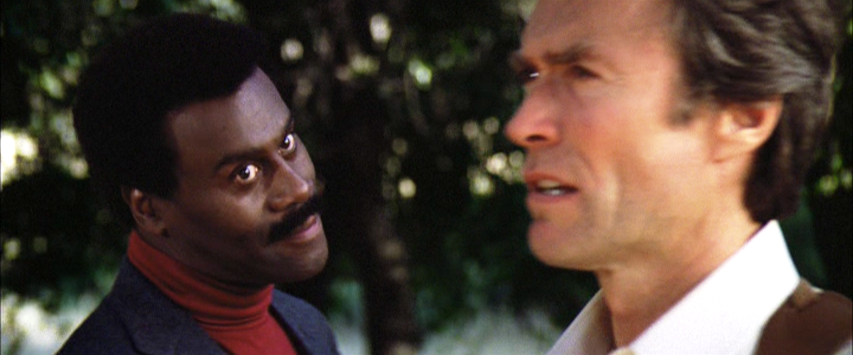
Loyal followers of the Dirty Harry series were probably starting to put two and two together, and they were undoubtedly surprised to see Popwell turn up yet again in the third film, The Enforcer (1976), as the revolutionary "Big Ed" Mustapha. Along with the added bonus of his character actually having a name this time around, Popwell was granted a considerably larger role; he has a long conversation with Eastwood that allows him to exercise his acting chops much more so than either of his previous performances. While still ostensibly on the wrong side of the law, the smooth Mustapha comes off as a reasonably likeable guy, and he provides Harry with information he needs to track down a group of murderous terrorists. This sympathetic turn foreshadows Popwell's final appearance in the series seven years later.

He shoots, he scores

1983's Sudden Impact, the first and only film in the series to be directed by Eastwood, would mark Popwell's last appearance in a Dirty Harry film, and his role brings him a full 180 degrees from the first film, as he plays Horace King, a cop and a close friend of Harry's. Cleverly introduced in a scene that makes it look like he's sneaking up on Harry with bad intentions, it's revealed that they're actually participating in a bit of rural target practice together, though Horace's shotgun proves to be no match for Harry's new .44 magnum AutoMag. Throughout their conversation, Horace continually refers to Harry as a "JAMF," leading to this amusing exchange:

                                     Harry: "What's the hell's a JAMF?"
                                     Horace: "That means you're a jive-ass mother..."
                                     Harry (interrupting): "Forget I asked."

The end of the line for Horace

Unfortunately, later in the film, Horace stumbles into an ambush meant for Harry and pays for his mistake with a slit throat. To make matters worse, the bad guys injure Harry's dog, Meathead, who had been a gift from Horace. As you can imagine, he's not pleased.


Sadly, Popwell was unable to appear in the final Dirty Harry film, 1990's The Dead Pool, due to prior commitments. It would have been fitting if this veteran actor had appeared in all five films. As it stands, his four appearances demonstrate that, in Dirty Harry movies, you only die twice.


Wednesday, October 26, 2011

Cannibal Apocalypse

This blog post is part of The Italian Horror Blog-a-thon at Hugo Stiglitz Makes Movies. Be sure to check out the other posts!

Making the world safe for democracy. And cannibalism.
As any connoisseur of Italian horror films knows, the late 1970s and early 1980s saw an explosion of films that graphically showcased flesh eating of one sort or another. Most of the films in question were either zombie films, in which the dead return to life to devour the living, or cannibal films, which typically featured American or European explorers running afoul of peckish natives in the jungles of Asia or South America. The zombie films, of course, were all derivatives of George Romero's 1978 classic Dawn of the Dead, which was a big hit in Italy, while the cannibal films were a sort of ultraviolent mutation of the mid-70s Italian adventure film Man From Deep River, which was itself inspired by the Richard Harris western vehicle A Man Called Horse. Whichever camp they fell into, these films reveled in the same types of gruesome sights: hunks of bloody flesh being bitten out of people, limbs being severed and gnawed on and gobs of entrails being pulled out of torsos and devoured. One film took elements of both zombie and cannibal films and mixed in yet a third: the Vietnam War action-drama, in vogue at the time thanks to such high-profile Hollywood blockbusters as Michael Cimino's The Deer Hunter and Francis Ford Coppola's Apocalypse Now. The result was Antonio Margheriti's opportunistically titled Apocalisse Domani (translation: Apocalypse Tomorrow), directed under his well-known pseudonym Anthony M. Dawson. Like most films of its type, it acquired a number of alternate titles, including Cannibals in the Streets, Invasion of the Flesh Hunters and the one it's now generally known by, Cannibal Apocalypse. While the film is far from a classic, it's actually a cut above many of its contemporaries, thanks to some decent acting, relatively complex characters and a couple of showstopping gore effects. There are spoilers ahead, but do you really care?

Are you gonna eat that?

Like a number of other Italian horror films made during the same period, Cannibal Apocalypse was partially shot on location in the United States; in this case, Atlanta, Georgia. The inimitable John Saxon stars as Colonel Norman Hopper, a Vietnam veteran. The film opens with a flashback to the war, in which Hopper and his unit commence an assault upon a Vietnamese village. Discovering two American soldiers being held captive in a pit, he is horrified to realize that they are feasting upon a Vietnamese woman who tumbled into the pit after being burned by a flamethrower. While he's temporarily frozen with shock, one of the men bites Hopper on the arm, at which point he awakens from his nightmare. This opening sequence betrays the film's obviously low budget, as all of the helicopter scenes are grainy stock footage, and we don't see any of the actual actors until after the characters have disembarked from the chopper. Nevertheless, Margheriti handles the action scenes with flair, and the scenes of the soldiers eating the woman gets things off to a suitably gruesome start.

John Saxon, not phoning in his performance
Hopper is troubled by his recollections of the incident in the pit, while his wife, Jane (Elizabeth Turner), a local television host, struggles to support him. In the midst of rebuffing a clumsy attempt at seduction from Mary, the teenage girl next door, Hopper receives a call from fellow veteran Charlie Bukowski, portrayed by instantly recognizable Italian actor Giovanni Lombardo Radice (aka John Morghen). Anyone who's seen more than a few Italian horror films of this vintage will know that Lombardo Radice's mere presence gurantees the inevitability of some extreme gore. Bukowski, of course, was one of the two cannibalistic soldiers in the pit; along with the other soldier, Tom Thompson (Tony King), he has been doing time in a psychiatric facility, oh-so-conveniently located in Atlanta. Bukowski has received a weekend pass, which will later turn out to be a poor choice on the part of his doctors, and he wants to hook up with Hopper for a few beers. Hopper, while initially enthusiastic, flashes back to Bukowski and Thompson chowing down on the poor Vietnamese woman and changes his mind pretty quickly. He then decides that Mary looks pretty fine after all in her multicolored tights and proceeds to get busy with the young lass, apparently biting her in the process (she just thinks he's being kinky).

If they were still in the military, this would be considered insubordination
Bukowski, upset by Hopper's dismissal, decides to take in a movie by himself. A young couple sits in front of him and embarks upon a ludicrously over the top makeout session (they practically have sex right there in the theater). Bukowski, apparently unsatisfied with his buttered popcorn, can't help himself and bites a chunk out of the woman's neck; a melee ensues. Escaping from the theater, he finds himself holed up in a nearby flea market. A motorcycle gang, whose path he had previously crossed, decides to go all vigilante and pursues him through the flea market on their bikes, smashing the place to smithereens. Stumbling upon a gun dealer's stall, Bukowski arms himself and blows away one of the bikers. A security guard, who apparently missed the fact that motorcyclists were destroying the flea market, is alerted by the gunfire and is himself shot by Bukowski. Eventually, the police arrive, under the command of the hilariously foul-mouthed Captain McCoy (Wallace Wilkinson). The captain drops such eloquent witticisms as "He's gonna be singin' out his asshole when I get through with him" seemingly effortlessly. Eventually, Hopper finds out about the situation and comes down to the scene. He talks Bukowski into turning himself in, but Bukowski bites a cop's finger in the process of being arrested. He's taken not to the police station, however, but back to the hospital. As he's being readmitted, a fracas erupts and a female doctor is bitten by Thompson.

He wouldn't put down the boob
It should be obvious at this point that Bukowski and Thompson picked up a virus that causes cannibalism while they were POWs and transmitted it to Hopper via the bite on his arm. I know - a virus that causes cannibalism? The movie attempts a half-assed explanation of this nearly incomprehensible concept with a hilarious exchange between Jane and her friend, who also happens to one of the doctors treating Bukowski and Thompson. It goes something like this:

Jane: "What I don't understand is how a social phenomenon like cannibalism can become a contagious disease."
Doctor: "By means of some sort of biological mutation due to a psychic alteration."

OK then, there's your explanation, let's move on. They also don't explain why the virus took so long to surface in Hopper, while everyone else seems to become infected pretty damn quickly. Then again, these films aren't known for their airtight logic. As the police realize that the bodies of Bukowski's victims were partially eaten, the cop who was bitten turns cannibal shortly after returning to the station. He attacks a female officer, rips off her breast and starts eating it, leading to the all-time classic line from Captain McCoy, "Oh my god, put it down, son!" Needless to say, the confrontation doesn't end well.

When she said, "slip me some tongue," he didn't fully grasp what she meant
Meanwhile, Hopper is persuaded to have himself checked out at the same facility where Bukowski and Thompson are being detained. The female doctor who was bitten by Thompson turns cannibal and bites off her boyfriend's tongue before smashing his head in with a paperweight. She then frees Bukowski and Thompson. As an orderly is about to call for help, Hopper kills him. Realizing they're all in the same flesh-eating boat, the four of them team up and hit the road in a stolen ambulance. At a gas station, they kill the attendant and use an electric saw to cut off one of his legs as a sort of takeout meal. Of the hundreds of gory special effects I've seen in films of this nature, I've always found this one to be one of the most realistic and revolting. It goes on for a good long while and really does its best to sicken the viewer with its nauseating detail. I'm not sure if the incongruously jaunty disco music that plays over the scene makes it better or worse.

Come on down to the sewer - we'll have a (shotgun) blast!
Stealing a car, the cannibal gang gets into a scrape with the remaining members of the motorcycle gang, decimating them in short order. With the cops hot on their trail, they take to the sewer, where they're hunted down one by one and exterminated like the rats who are their subterranean companions. The female doctor is shot to death first. Bukowski's death is the stuff of legend; when he's unable to make it through a set of bars in time, the cops blast his guts out with a shotgun, allowing the camera to peer through a gaping hole in his midsection (a stunning practical effect that would be done badly with CGI nowadays). In an echo of the film's Vietnam opening, Thompson is incinerated with a flamethrower. Only Hopper makes it out, but he's gravely wounded. He exits the sewer and makes his way home, where he encounters Jane and her doctor friend, who's been infected. The doctor bites Jane, Hopper shoots the doctor and then he and Jane have a tender moment before ending things with a mutually agreed-upon murder-suicide. The police show up just in time to mop up, leaving Captain McCoy to declare that "this fuckin' nightmare is over." It isn't, of course. Remember Mary, she of the multicolored tights? Hopper infected her with his love bite, she apparently infected her little brother (not going there), and the penultimate shot of the film is of their bitchy aunt's bloody arm sticking out of the fridge. Despite leaving the (refrigerator) door open to the possibility, however, there was never a sequel, which is astonishing, given the fact that the Italians took it upon themselves to sequelize films they never made in the first place. It's worth noting that, unlike several of his peers, Margheriti never made another film that featured flesh eating; indeed, this was essentially his last horror film, although he continued to direct for many more years. Most of his earlier horror films had been of the gothic variety, with castles, crypts and Barbara Steele; it's almost as if this foray into modern, explicit horror soured him on the genre for good.

Jane, stop this crazy thing!
Cannibal Apocalypse delivers everything that's expected of an Italian exploitation film, including a goofy plot, a groovy score, some ludicrous dialogue and of course, some serious gore, but it goes the extra mile and actually becomes a reasonably effective film, thanks in large part to John Saxon's performance. Reportedly, he thought the film was a piece of crap and only accepted the role to pay the bills, but you wouldn't know it from his convincing portrayal of the tormented Colonel Hopper. Really, though, has this man ever phoned in a performance? Also giving a respectable performance, despite having had his English performance dubbed by another actor, is Giovanni Lombardo Radice as the ill-fated Charlie Bukowski. Lombardo Radice's notoriety as the star of several of the most gruesome death scenes in Italian horror film history (he had his head ventilated with a huge drill in Lucio Fulci's City of the Living Dead and he had several rather important appendages lopped off before having his skull converted into a bowl of brains in Umberto Lenzi's Cannibal Ferox) means that his acting style is probably best remembered as screaming and grimacing, but he actually brings some depth and sensitivity to the character of Bukowski. In particular, during their scenes together in the flea market, he holds his own with Saxon. When the cops launch tear gas canisters into the building (only to have them Bukowski deactivate them by urinating on them after Hopper reminds him of this solution), you assume they're the cause of the tears streaming down Bukowski's face, until you realize that Hopper's not crying. It's a nice touch. There's also another great scene in which the female doctor has turned cannibal and is advancing on her doctor boyfriend in the lab. He thinks she's just horny, but she's got something else entirely in mind, and it's pretty creepy. Actress Elizabeth Turner is lovely and sympathetic as Hopper's wife Jane, and their final scene together is actually pretty emotional as far as these things go.

Are they going to hire us for Cannibal Apocalypse 2?
Another thing that makes this film more interesting than most of its type is the blurred line between the heroes and the villains. Clearly, we're meant to sympathize with Hopper and his band of misfits, even though they perpetrate some pretty awful crimes against innocent people throughout the film. Somehow, we're able to overlook these atrocities and continue to root for them, perhaps because we know they're driven by a biological compulsion and can't help themselves. The other ostensible protagonists of the film - the police and the medical professionals - are either portrayed as unsympathetic or clueless. It's interesting to note that the central figures in this film exactly mirror the demographics of the heroes of Dawn of the Dead: two white men, an African-American man and a white woman. Both groups are doing their damndest to survive, but while the heroes of Dawn are mostly fighting against mindless zombies (and, not surprisingly, a biker gang), the "heroes" of Cannibal Apocalypse are generally pitted against "normal" society.

Leftovers again?
If I haven't mentioned the Vietnam angle that much, it's because the film doesn't seem too concerned with it, either. It's essentially a plot device, as well as another way to imitate popular films of the time to sell tickets. If you wanted to read more into it, you could look at it a few different ways. The cannibal virus could be seen as the worst possible form of Post-Traumatic Stress Disorder; Western society's punishment for ignoring its veterans and/or fiddling about in the affairs of other countries. Conversely, it could be a stand-in for the evils of Communism, brought back from Vietnam to infect our Capitalist society. It's hard to imagine that the filmmakers were thinking about things that deeply, though. In the end, Cannibal Apocalypse is not much more than an entertaining piece of junk that, despite its derivative origins, lingers in the mind a little longer than most.

Wednesday, October 12, 2011

Six Degrees of Kevin Bacon's Jugular - Friday The 13th Uncut

It's funny how things change over time. Twenty-five years ago, an uncut Friday The 13th would have been at the top of my must-see list. At the top of a different list, the one having to do with shit, would have been the MPAA, whom I held personally responsible for my inability to watch Friday The 13th and other films of a similar nature in their unadulterated form. You kids nowadays have no idea what I'm talking about, but believe it or not, filmmakers used to have to cut all of the gore out of their movies or they'd be threatened with an X rating. What's an X rating? Do I have to explain everything? Fine.

Long ago, an X was the only rating higher than an R. It was initi
ally created to apply to films that were considered too mature for children of any age to see. Several well-respected films received the X rating, including the 1969 Oscar winner for Best Picture, Midnight Cowboy. Eventually, though, the X was appropriated by the adult film industry and became irrevocably associated with porno. (Now, of course, its counterpart is the NC-17 rating. What? You've never heard of that one, either? Kids these days...)

While the MPAA never forced anyone to edit their films, the X rating became the kiss of death for a mainstream movie, as most theaters wouldn't show movies that were rated X and most newspapers wouldn't accept advertising for them, so if the MPAA said "lose this scene here and that scene there or you'll get an X," the studios did what they were told. A few independent films, such as Dawn Of The Dead, were brave enough to bypass the MPAA and go out unrated, but by and large, the MPAA effectively neutered the American horror film for quite some time.

This little history lesson leads us back to Friday The 13th. As an avid reader of horror film magazines at the time, I was painfully aware of the elaborate gore effects that were concocted by talented FX artists for films like Friday the 13th and its sequels, but inevitably, they would be drastically trimmed or cut out altogether by the time the films were released. This was long before the days of special unrate
d DVD releases, so horror fans like myself could only sit there and stew, cursing Jack Valenti's name in our frustration. I even wrote a paper trashing the MPAA for a college writing class. Although he gave me an A, the professor remarked in his notes, "Your tone seems a bit hysterical." I'll never forget that.

Finally, in 2008, the uncut version of the original Friday was released on DVD. You'd think after all these years, I'd have jumped at the chance to finally see it, but as I said before, things change, and it just wasn't a priority at the time. About a month ago, out of the blue, I had an urge to see it, so I checked out a copy from the library. (If you'd have told my younger self that the uncut version of Friday The 13th would one day be available on a disc the size of a CD at my local library, I'd have shit a brick.)

So, was it worth the wait? I'd say yes. While Friday The 13th is not a particularly good film, it is a fun one. As inexperienced as they may have been, the filmmakers made a few wise decisions. They hired Tom Savini to create the gruesome special makeup effects. They added a now legendary shock to the end of the film that still makes people jump, even when they know it's coming. And perhaps most importantly, they hired Harry Manfredini to compose the score. I can't imagine the film being nearly as effective without its superb musical accompaniment. As much as I love John Carpenter's chilling synthesizer score for Halloween, nothing adds a layer of class to a film such as this like a symphonic score, and Manfredini's iconic music is still great. As far as the uncut version goes, it was fun to see the extra few seconds of blood squirting out of Kevin Bacon's neck, and the restored axe-to-the-face effect was pretty cool, too, but in all honestly, the first film made it through the ratings process relatively unscathed, and the film is just as effective either way. Anticlimactic? A little, yeah, but it's always good to have the version of the film that someone told you you weren't supposed to see. Take that, MPAA.


One last thing. Watching this film again made me wonder how is it that the killers in these movies manage to string up the dead bodies so that they'll come flopping down right when someone is running by. Is there some sort of special knot? A triggering mechanism? Do they teach these things in slasher school?

Monday, October 10, 2011

Italian Horror Blog-a-thon


OK, it's official: the Summer of Sam series is dead. It's October, for God's sake. I guess I bit off more than I could chew, given all of the time I've had to devote to work and school lately, and I started way too late on top of everything else. I would still like to tackle it at some point. Maybe next year.

In the meantime, though, I will be posting some other horror-related stuff (it is Halloween month, after all), including a few entries in the Italian Horror Blog-a-thon over at Kevin Olson's blog, Hugo Stiglitz Makes Movies. Keep watching this space.